
Change order management to subcontractors is among the biggest risks to the construction profit margin. An undocumented change order, even more so.
Consider: the crew does the extra work, the paperwork lags or doesn’t get filed, the schedule does not change, and the subcontractor inevitably absorbs the cost.
Typically, subcontractors finance the out-of-pocket costs, do the extra work, and bill it all later just to keep the job moving along. If there is a lapse in paperwork or the GC delays the approval, these costs directly impact profitability.
On top of all that, the real costs may exceed a subcontractor’s typical markup, resulting in a net loss on the changed work.
Change orders can also cause delays that put other work behind schedule, as subcontractor crews have to adjust their schedules and wait on materials, leading to trade stacking and a ripple effect of delays, budget overruns, and disputes with the client or the GC.
Ultimately, trying to prove verbal approvals after the fact, often weeks after the work has been done, has little chance of success without a great deal of effort. Once the work has been done, subcontractors are in a weak negotiating position.
Today’s article will cover change order management, subcontractor construction cost control, what to track, and why each item matters.
What counts as a change order on a subcontractor’s job?
Change orders are intended to permanently alter the scope of the original contract in terms of budget, design, or schedule.
RFIs are used by contractors and subcontractors to request information from engineers, architects, or clients regarding a specific aspect of a project, such as when a detail needs clarification before work proceeds. An RFI response may trigger a change order or could create work outside the original contract scope, in which case a T&M ticket is handy.
A T&M (time and materials) contract is a billing agreement in which the subcontractor is paid for time worked and materials used, plus a markup, within the scope of a change order.
Understanding what qualifies as a change order protects subcontractors from absorbing the cost of work they do outside the original contract. A change order is a legal document that lays out how the work will be done, how much it will cost, and how much time it will add to the timeline.
Common triggers for change orders include scope changes, unforeseen conditions, or owner-directed changes.
Change orders can be billed either as a lump sum or on a T&M basis. The contractor and the client must sign off on it to make it binding.
However, this is precisely where things can go very wrong for the subcontractor. A signed change order is often the only way a subcontractor gets paid fairly for the additional work. Ensuring it is signed before actually doing the work protects them from having to absorb the costs, which is particularly important as GCs typically cap markups on change orders at 10-15%.
The trouble is, many subcontractors will forge ahead on a handshake just to keep things moving, but doing so is a massive risk that almost always results in a loss.
The non-negotiables: what every change order needs
Once a potential change is identified, a written notice must be issued before a change order can be submitted. Typically, this should happen within 7-14 days after the change is identified.
It is the contractor’s job to submit a change order request (COR) outlining the details of the change, why it is needed, the cost impact broken down by labor, material, and equipment, how it will affect the schedule, and any resulting delay claims.
Supporting documentation, such as photos, field notes, and a signed directive from the GC must be included.
Approval signatures from the general contractors and the project owner/client must be obtained before the work proceeds, but in some cases, a documented verbal directive may be sufficient when time does not allow. The keyword here is “documented,” as non-documented changes or hearsay can’t be proven in a dispute.

Why undocumented changes erode margins
Disputes over change orders tend to proceed with a specific pattern after the contractor submits the invoice.
If there is no T&M in place, the GC will dispute the scope. If the subcontractor lacks proof of the work done, payment stalls, and cash flow dries up.
The subcontractor is forced to eat the cost of labor and materials with little chance of recovery. They often pay for labor, tools, and materials out of pocket, and without a signed contract, they have no legal leverage to compel the GC to pay.
GCs often reclassify undocumented work as “included in the original scope” at closeout, so the subcontractor has no recourse unless they want to enter into litigation. And without documentation or proof of some kind, a lawsuit is unlikely to succeed.
In addition to losing money, the subcontractor loses trust and credibility, and will likely get even less benefit of the doubt on the next job, if indeed there is one.
So, when the GC says, “Just do the work, we’ll sort it out later,” it’s to your advantage to get it in writing. Otherwise, recovery might not happen.
In addition to what’s not documented, subcontractors must also pay attention to what is stated in the contract. Contracts often have a clause that says payment is forfeited if a change isn’t documented within a set period after the verbal notice. There may also be an integration clause in the contract stating that verbal orders from a GC are not legally binding. Signing monthly progress lien waivers may also negate a subcontractor’s right to collect.
Any oversight, whether it’s buried in the fine print or an undocumented change, can result in loss. Without a standardized change order process, these things happen more often than you’d want to believe.
Building a repeatable change order process
Standardizing intake will organize how changes are flagged in the field. Keep this idea firmly in mind: if it takes longer than 24 hours to document a change, you are losing money. A repeatable process is sustainable and protects your margins from eroding further.
Crews must be able to identify variances right away. To this end, foremen must be provided with a concise checklist of what is and is not in the estimate so they can jump on it immediately.
Out-of-scope items may include rework due to trade stacking and unprepared work areas. Details must be documented with a series of photos: one close-up, one wider-angle shot to provide context, and one of the specific location or gridline.
Your teams should also establish a few guardrails to prevent undocumented work from moving forward. For example, when a GC issues a verbal directive, your foreperson should immediately ask for a text or an email to confirm.
If schedule or safety is at issue, the foreperson must complete a T&M ticket and obtain the GC’s signature to verify the time and materials used.
Even if the final cost can’t be estimated, send a Notice of Variance to the GC within 48 hours of discovery. Email is generally sufficient to provide the required paper trail.
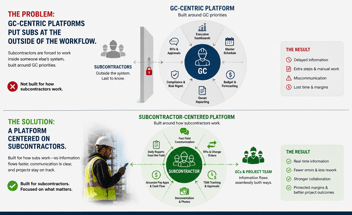
Documentation should be attached to the job rather than buried in complex email threads and paper documents, as it helps keep things tidy. Subcontractor software like eSUB helps manage these processes by providing templates and cloud storage for all files, correspondence, and documentation attached to each job.
How eSUB supports airtight change order documentation
eSUB automates field capture and helps subcontractors lock in the legal proof they need to establish an auditable “paper” trail. By turning random conversations into verifiable proof, subcontractors have a simple, intuitive, and repeatable way to manage construction cost control.
Time gaps between discovery and documentation can be a costly issue, and eSUB eliminates the lag, helping foremen and their teams log work in the moment, upload photographic documentation, and collect digital signatures directly from a mobile device.
Subcontractors can pre-load labor and contractually agreed-upon markups into the system, preventing uncaptured overhead from slipping by and providing pricing transparency.
Change order management for subcontractors has never been easier. T&M approvals are substantiated, and missed deadlines are a thing of the past as the system logs precisely when the GC received the notification, and disputes fade to a minimum at closing, as you’ll have an airtight, timestamped audit trail in case anything is called into question.
Transforming change order management for subcontractors
For trade contractors, change order management is always a high-stakes process. Unapproved expenses can quickly erode margins and drain cash flow, and can even wipe out the expected profit from an entire job.
If change orders and T&M go undocumented until closeout, there’s little chance of recovery. eSUB was created to solve these issues for trade contractors, providing them with a purpose-built platform that helps them document changes, capture signatures, and establish a legal basis to ensure they get paid for the work they do.
Request a demo of eSUB to see it in action, or browse our archive to learn more.