Construction tech has transformed how projects are planned, managed, tracked, and delivered. But despite this industry-wide evolution, most platforms remain inordinately biased toward general contractors (GCs) and don’t fully meet the needs of trade contractors.
The underlying assumption is that GCs are the primary customers and are at the core of the workflow.
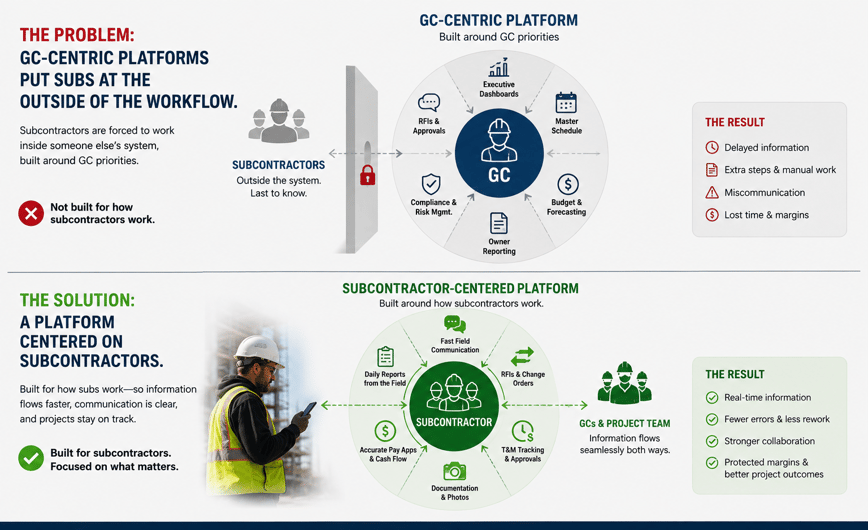
So, instead of having a platform centered around subcontractors, they are invited to engage with GC workflows, which essentially means they’re centered on someone else’s priorities.
It’s not that the construction software lacks features, but rather that it doesn’t address how trade contractors actually work
Without the right tools and workflows, there will be gaps that resonate through every aspect of the job, from field operations to cash flow, documentation, and project delivery.
As the landscape evolves, the question we should be asking is: why are trade contractors still expected to use systems that weren’t designed for them?
The GC-First Design Assumption
Before we get into it, it’s important to understand why mainstream platforms look and behave the way they do.
GCs have a lot on their plates. They coordinate with dozens of contacts — subcontractors, owners, engineers, and architects — while maintaining the master schedule and budgets, and keeping everyone aligned through reports and communications. Naturally, their software supports these needs.
Dashboards prioritize executive-level visibility, scheduling centers on project milestones, and documentation has complex approval chains that go through several levels before the information lands with the subcontractor. And for the GC, it all makes perfect sense.
The subcontractor’s workflow is quite different.
Ultimately, subs need to get information to the GC fast, track it until a response comes back, and seamlessly relay the responses to their field crews to keep things moving. For them, they are tracking the execution of the project.
Using a GC focused platform is like being forced to live in someone else’s world, full of unnecessary rules. The difference is that most GC software is designed for project oversight, while subcontractor-centric workflows focus on execution.
Software, by its very nature, should adapt to the business, not force the business to adapt to it. And while it may start as a minor inconvenience, the issue becomes more evident as companies grow. If the company needs to manage multiple projects simultaneously or expand into new regions, this becomes a liability.
Subcontractors don’t think the same way as GCs. Owner dashboards and reporting structures aren’t the first thing on their minds. What they do think about is their own crew's productivity — installations, completed work, equipment usage, weather impacts, safety concerns, and the delays outside their control — the dozens of small decisions it takes to keep their piece of the job on schedule. Foremen and Project Managers need a simple, quick workflow to track progress and issues, so they can spend more time keeping the crew moving and less time on paperwork.
Billing is another challenge altogether.
GCs manage owner and project billing cycles and schedules, whereas subcontractors, who work under time-and-materials (T&M) contracts, unit pricing, phased installations, and change orders that directly affect their own labor costs, productivity, and profitability.
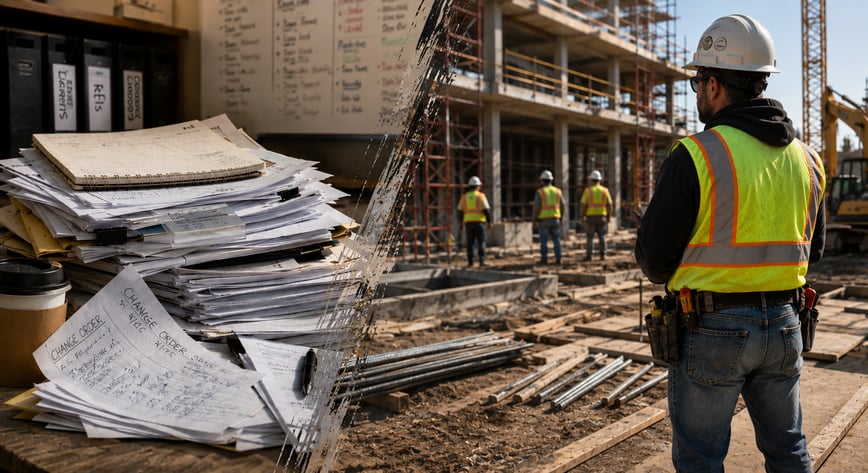
Change orders are a particular challenge. A missed approval deadline or insufficient documentation can result in thousands of dollars in unrecoverable costs. If you’re tracking these details in a spreadsheet, in complex email threads, or texts, it’s too easy for something to fall through the cracks. If a dispute arises, it’s next to impossible to retrieve the information, and margins suffer.
The Cost of the Gap
Inefficiency is aggravating, but it’s also costly.
Every minute spent reconciling emails, texts, and outside application data to spreadsheets is time that could be better spent managing projects, crews, or securing new work.
As companies grow, the time multiplies across every touchpoint and project manager. And it’s not just time that’s an issue. Documentation gaps are much more consequential.
Our Founder frequently says, “It’s not about the work you did; it’s about the work you documented.”
Disputes are rarely about whether the work was completed, but if it was documented, approved, and completed as specified.
Subcontractors have much tighter margins and less financial flexibility than GCs. If the software does not address these critical workflows, the result can be financially catastrophic. Any billing delays, incomplete documentation, or missing approvals can significantly impact cash flow and have an immediate impact.
To be clear, it’s not an issue of poorly made software; it’s just that the software being used targets GCs with different priorities.
What Subcontractor-First Software Looks Like
To close the tech gap, we need to apply a different perspective. Trade-centric software asks the question: how do subcontractors work?
The answer starts in the field.
Information must flow between the field and the office with ease.
Daily reports should capture specific field data such as labor, progress, photos, equipment and material usage, delays, weather conditions, etc., that can be referred to in the future if disputes arise.
Simplified workflows for tracking RFIs, change orders, and T&M work allow the subcontractor to get their questions answered and keep the documentation they need to support payment requests and resolve disputes.
The field and the office should be connected by a single workflow, rather than relying on separate systems or spreadsheets.
This all circles back to the statement that software should adapt to the businesses using it, not the other way around, and that’s the philosophy that’s guided eSUB’s approach to construction technology.
We are not repackaging or adapting GC workflows. We genuinely understand the needs and operational realities of subcontractors and have designed technology that directly addresses the challenges they face every day.
Looking Ahead
The subcontractor tech gap isn’t about a lack of features or functionality. It’s a gap in design philosophy. GCs build systems that protect their own interests — so why should subcontractor software be any different?
If subcontractors keep forcing their workflows into systems that don’t respect their priorities and protect their profit margins, they’ll keep bleeding time and taking unnecessary risk, to the detriment of their growth.
Your software investment should be an advantage, not a handicap. Tools built around your reality remove barriers and help you move forward with greater confidence, efficiency, and profitability.