
Cash flow is the lifeblood of any business. Even profitable companies might fail when payments are delayed, while less profitable companies may survive if the cash keeps moving.
The success of every job, every decision made, and the business itself depends on being paid on time.
And yet, many trade contractors still view progress billing as an administrative burden. Documentation is gathered from multiple, disconnected sources, applications are created under deadline pressure, and disputes become a “normal” part of the day-to-day, with delays seen as inevitable.
Easily, the biggest operational vulnerability for trade contractors is cash flow. Fortunately, there’s a way to solve it through progress billing transparency.
When every billed dollar is substantiated by documented progress and total visibility into the billing process, the payment workflow shifts from negotiation to verification. And while transparency doesn’t prevent all delays, it vastly reduces the friction between subcontractors and GCs, helping firms get paid faster for the work they’ve done.
By viewing progress billing as a strategy rather than a burden, subcontractors can protect their cash flow, preserve margins, and strengthen relationships with the GCs who rely on them.
The progress billing problem trade contractors face
Subcontractors regularly struggle to get paid because they can’t prove the work they’ve done. It’s not about the quality of the work; it’s about having the documentation to support it.
With progress billing, this often comes down to disputes surrounding the schedule of values (SOV).
The SOV is meant to establish an understanding of how work is billed throughout the project. Still, it often becomes contentious when disputes arise over interpretations of completion percentages, overly broad line items, or scope creep.
Pay applications add another layer of potential contention. If certification documentation is missing, if progress reporting is inconsistent, or if there happen to be differences between the field and the back office, revisions or outright rejections may ensue. And if they do, you can expect multiple rounds of phone calls, emails, and document requests before anything gets resolved.
These are the kinds of delays that can be the death knell for subcontractors.
While GCs typically have large reserves and greater control over payment approvals, subcontractors have ongoing obligations. Workers, vendors, and suppliers expect to be paid promptly, and the work can’t stop just because an invoice is in review.
In most cases, the subcontractor absorbs the cost until it’s resolved, which puts them in a negative cash flow position.
Bottom line, if there is friction around progress billing, it’s typically because of a lack of visibility into how the work is documented, communicated, and verified.
How progress billing transparency changes the dynamic
Progress billing transparency swaps out uncertainty for objective, verifiable information.
Billing discussions become far less subjective when SOVs are clearly structured and include documentation.
GCs won’t have reason to question percentages of completion when the documentation substantiates field activity. Working from the same documentation is key here, as it removes the ambiguity and admin delays.
Daily reports, photos, and proof of milestone completion establish a continuous narrative that keeps the billing cycles moving forward, and documentation is created as the work is done.
Being proactive about this process accelerates payment timelines because the information is available before any questions arise. Field supervisors won’t have to recreate weeks of activity from memory; completed work is connected to the appropriate line item, and GC relationships become stronger because the process makes their jobs easier.
GCs value any effort to reduce friction. When billing is organized, documentation is where it’s supposed to be, and progress is substantiated by verifiable proof, payments are better for everyone.
Firms known for billing transparency can expect fewer disputes, smoother project closeouts, and more future bids, as attention to detail here can lead to opportunities long after the current job is complete.

What transparent progress billing requires
Transparency is intentional. It relies on capturing accurate information in the field and having it carried consistently through the billing cycle.
A clearly defined SOV is the foundation.
SOVs, when presented in static spreadsheets at kickoff, won’t work. Instead, it should closely reflect how the work is performed and billed. Line items should include enough detail to paint a picture of the job’s progress without adding to the admin burden. As the work progresses, billing updates should correspond to milestones and be supported by documentation.
If you are collecting documentation after the work is done, searching for photos in disconnected email threads, or reviewing daily reports only after a dispute has been raised, your cash flow is at stake.
Documenting work as it happens builds a much stronger foundation for progress billing. Documentation and completed milestones accumulate naturally as the project progresses instead of always being an eleventh-hour rush before the pay application goes in.
Above and beyond real-time visibility, what you’ll gain is an audit trail.
Billed amounts will connect directly to evidence showing the work was completed, when it happened, and how it ties into the SOV. When documentation and billing support each other, questions are easier to resolve because the data exists.
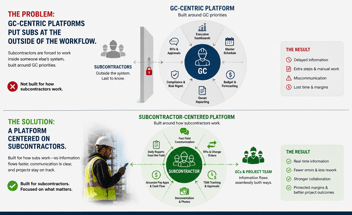
Having visibility across the entire project team is, perhaps, just as critical. Back office, field workers, and PMs need to access the same information. When everyone works from a common source of truth, friction melts away, and everyone can get on with their work.
Technology alone can’t create transparency, but it sure helps. The right software makes documentation processes more consistent and easier to manage across every project.
How eSUB’s new progress billing functionality supports this
Construction projects don’t often progress as smoothly as everyone would like. Work straddles multiple billing periods, the scope often changes midstream, and single line items may be completed over several pay applications rather than all at once.
Traditional billing tools don’t typically support these realities, resulting in manual workarounds and an increased risk of error.
eSUB’s new progress billing functionality was designed to solve these problems.
Instead of treating each billing cycle as an isolated event, eSUB treats it as an ongoing process. As a result, foremen and back-office teams gain visibility into partial cycles, making it easier to track work completed over time and to align what goes on in the field with financial reporting.
If less manual reconciliation, fewer disconnected spreadsheets, and greater confidence that every pay application is consistent with the state of the project sounds pretty good, it’s well worth the time and effort to try eSUB out.
Facing Forward
To ensure positive cash flow, you need to get paid promptly for work done. And though technology can’t eliminate all potential for disputes and payment delays, transparent progress billing provides subcontractors with improved control over factors they can influence.
Accurate SOVs, real-time documentation, and connected billing records build trust, help to resolve disputes quickly, and keep payments moving forward.
You’ll be transforming progress billing from reactive to proactive, reducing the associated admin work, and improving cash flow before the first daily report is filed.
Subcontractor work has always been competitive. Firms that favor transparency, accountability, and joint effort will always be the first call.
Progress billing transparency is about more than just paperwork; it’s about improving your financial strength, building stronger relationships, and taking ownership of the processes that protect your margins and strengthen your bottom line.