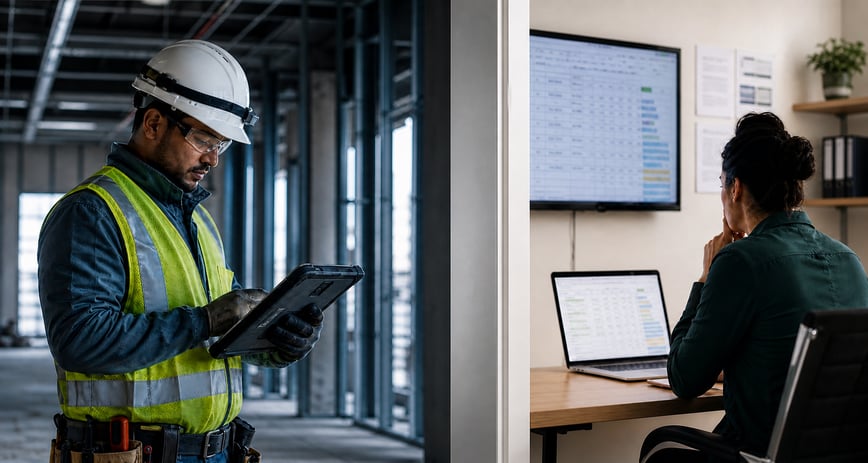
It’s Friday afternoon, timecards are trickling in from the week, but they aren’t telling the whole story. Communication between the office and the field has been spotty, so there is an assumption that things are going as planned.
But you know what they say about assumptions.
By the time the office knows about a delay, undocumented change order or new directive, the cost is already unrecoverable. Schedules adjust, work scope starts to creep, changes go undocumented, and ultimately the subcontractor is left holding the bag.
Unapproved T&M work and trade stacking break budgets. Payments are delayed until the details are confirmed and signed off, directly impacting cash flow, project management, and client relationships.
Most subcontractors don’t lose money because of poor workmanship; they lose it because they did not document the delay, make notice of the change under protest, or record and get authorization for the extra work in the field. Without real-time notifications, field documentation and digital authorization signatures they get stuck in a reactive mode playing catchup to an ever-changing schedule with no real documentation or defense.
Subcontractors today face tighter margins, labor shortages, more complex projects, higher expectations, and far less room for error than ever before.
Streamlined communication, standardized processes, and improved field-to-office collaboration help to solve these issues. But if you’re still relying on spreadsheets, you’re (quite literally) living in the past.
Why the Reactive Model Was the Default and Why It’s Broken
The subcontractor industry has historically relied on paper daily reports, spreadsheets, texts, and phone calls. Unfortunately, these methods are the root of the problem.
Paper reports aren’t always delivered daily; spreadsheets might not be reconciled for days or weeks after the fact, phone messages tend to go unanswered, and texts don’t always accurately convey what’s really going on.
Software and systems built for general contractors don’t typically address the same challenges subcontractors face and need to be adapted (often inadequately) to the sub’s needs.
When margins had a cushion, these practices might have allowed you to squeak through. Today, many contractors are operating with only a few percentage points of profit, leaving little room for mistakes, rework, or labor overruns.
A week’s worth of undocumented labor overruns and out-of-scope work can wipe it all out.
This gap, the one between what happens in the field and when the office learns about it, is where your profit disappears.
As one of our peers so succinctly put it, you don’t get paid for the work you do – you get paid for the work you document. When the recorded data does not align with reality, the losses are often unrecoverable.
What Being Proactive Really Looks Like: Putting Real-Time Data into Practice
The goal of real-time reporting is to minimize the lag between an event and awareness of it. With the right approach, this time gap can be reduced from days or weeks to hours, helping you identify and mitigate issues before your profits evaporate.
Here are a few examples of real-time data in action:
- Daily reports are actually daily reports. Data is captured at the jobsite while work is underway, rather than at the end of the day on Friday, when paper reports are typically delivered.
- Verifiable paper trails. Time-and-materials (T&M) work is documented, and digital signatures are collected on-site. The office receives the reports immediately and can verify that the work was approved, allowing billing to proceed. Paper trails are established and verifiable in case of a dispute.
- Labor hours are tracked against the budget in near real time so that budget overruns can be corrected in week two, not at closeout.
- Single source of truth for all stakeholders. Project managers, field supervisors, and controllers are viewing data from a single source rather than relying on multiple inputs that arrive at different times.
The right software can provide you with the data visibility you need to align with field teams, office staff, and outside stakeholders. It also enables standardization, bringing more predictability to your processes, even when working with new people.
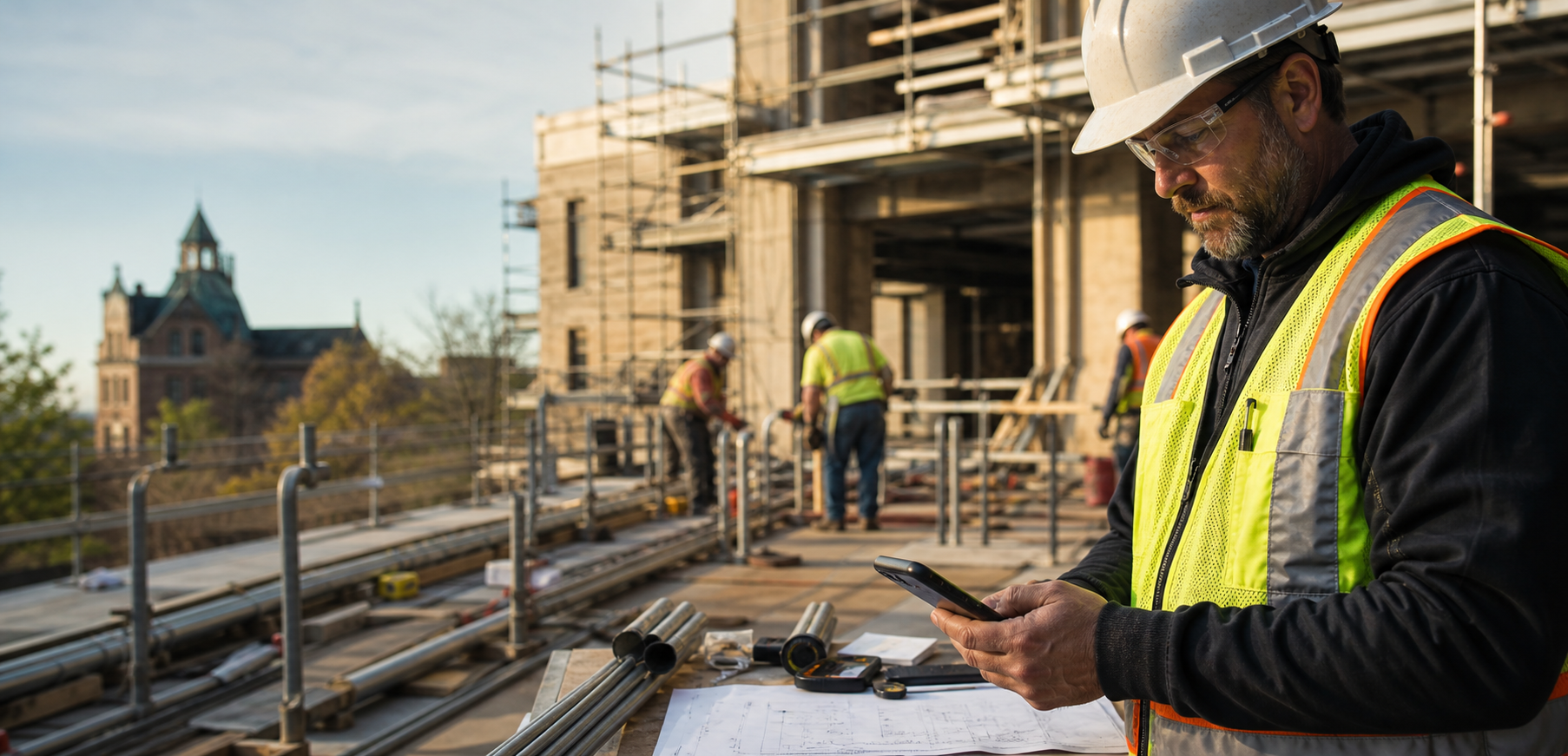
Labor Tracking: The Highest-Stakes Use Case
The measure of a company’s profitability often comes down to jobsite documentation and data visibility across teams. Because labor is the highest controllable cost for most trades, this is typically the area most ripe for transformation, but it also has the greatest potential for failure.
An electrical contractor on a university campus or a fire protection contractor doing a hospital expansion doesn’t have the luxury of discovering labor overruns at closeout.
Data-driven labor forecasting and resource planning must replace reactive scheduling. Leveraging historical data and visibility into upcoming backlog, companies can make smarter staffing decisions, stay ahead of labor shortages, and identify productivity issues early enough to adjust crews, resequence work, recover costs, or support change order claims before margins are impacted.
Field resistance is a common concern, which is why ease of use and relevance are essential. On the front lines, the solution needs to be simple and user-friendly enough for the least technically inclined, or it won’t be used.
If a tool is primarily designed for the back office, it won’t likely address the needs of the field team. True visibility can only be achieved if the capture occurs at the jobsite, and this cannot be accomplished solely on the admin side. Knowing where your hours are going helps protect your margin. In today’s labor-constrained market, this may be your most significant challenge, but it is solvable with the right mindset and solutions in place.
What Does the Next Five Years Look Like?
We are moving into a future where field operations, project management, and financial data are no longer siloed and can be leveraged in real time without extensive analysis or data science.
While it does not replace field expertise, AI can be helpful. For identifying patterns, highlighting risks, and automating documentation, there’s nothing like it. But we must also consider that each stakeholder has a unique focus and set of concerns. While profitability is the vehicle that keeps a company moving forward, it’s also important to ensure systems are simple and scalable.
If the software is complicated or requires cumbersome workarounds, you won’t likely get everyone on board. Data must flow in the right directions, provide actionable insight to users, and reduce the time commitment, data lag, and errors typical of manual workflows. Software that does not deliver on these promises won’t likely achieve ROI, so it’s vital to understand the problems you’re trying to solve and where the risk lies so you can evaluate solutions based on qualified criteria.
For many specialty contractors, the biggest obstacle isn’t adopting new software; it’s letting go of the spreadsheets and manual processes so ingrained in daily operations.
What Does Friday Look Like in a Proactive World?
Going back to the opening scenario, what would Friday look like if daily reports were delivered daily?
Ask yourself one question: right now, without making a phone call or opening a spreadsheet, do you know which of your active projects is bleeding margin?
If the answer requires a spreadsheet and a phone call, there’s a gap. Choosing a solution that’s purpose-built for specialty subcontractors ensures that the most influential workflows are captured, quantified, and digitized so you and your teams can focus on what you do best – not the paperwork.
The days of the foreman working from one set of information, the PM working from another, and accounting waiting for month-end updates are coming to an end.
Assessing your field-to-office lag is the first step on the journey. Empowering your team is easier than you might think.

.webp?width=352&name=JakePodcastblog%20(1).webp)